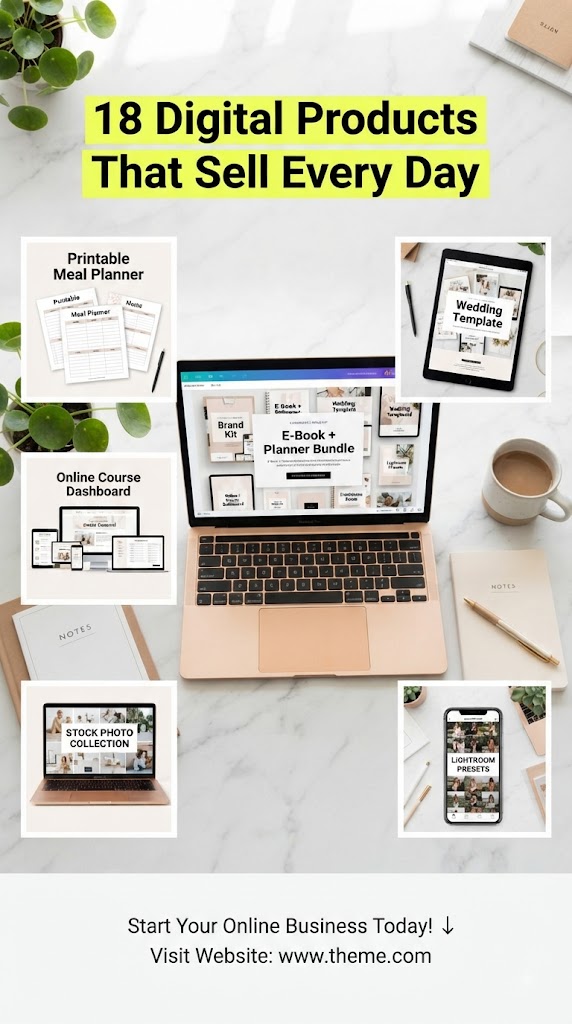
18 Digital Products That Sell Every Day: Your Blueprint to Passive Income
The landscape of the global economy has undergone a seismic shift. We are no longer tethered to the physical world of manufacturing, shipping, and inventory management to build a profitable business. Today, the most lucrative assets are invisible. They are digital.
Digital products are the holy grail of entrepreneurship. Unlike physical goods, they carry no storage fees, no shipping costs, and most importantly, you only have to create them once to sell them an infinite number of times. This is the definition of “scalability.” Whether you are a graphic designer, a coder, a fitness enthusiast, or a retired teacher, there is a digital product within you waiting to be monetized.
But what actually sells? The internet is crowded, and “build it and they will come” is a lie. You need products that solve real problems, satisfy deep-seated desires, or save people time. Here are 18 digital products that have proven, day-in and day-out demand.
1. Comprehensive Online Courses
The e-learning industry is projected to reach hundreds of billions of dollars in the coming years. People are moving away from traditional degrees and toward specialized, skill-based learning.
- Why they sell: They provide a structured path to a specific transformation.
- The Format: Video modules, workbooks, and quizzes hosted on platforms like Teachable, Thinkific, or Kajabi.
- Pro Tip: Don’t just teach a topic; teach a result. Instead of “How to Play Guitar,” sell “Play Your First 10 Songs in 30 Days.”
2. PDF Ebooks and Niche Guides
Ebooks remain a staple of the digital product world. They are low-friction, easy to consume, and highly portable.
- Why they sell: They offer instant gratification for someone looking for a quick answer to a specific problem.
- The Format: PDF or EPUB.
- Market Ideas: “The 30-Day Keto Reset,” “A Freelancer’s Guide to Paying Taxes,” or “How to Potty Train Your Puppy in a Weekend.”
3. Social Media Templates (Canva)
Small business owners, influencers, and marketing agencies are in a constant battle with the algorithm. They need fresh, high-quality content every day, but they don’t have the time to design it from scratch.
- Why they sell: They save hours of design time and provide a professional aesthetic.
- The Format: Shareable Canva links.
- Target Audience: Real estate agents, coaches, and e-commerce brand owners.
4. Adobe Lightroom Presets
Photography is more popular than ever, but editing is a specialized skill. Presets allow hobbyists and influencers to achieve a professional “look” with a single click.
- Why they sell: They democratize professional-grade photo editing.
- The Format: .dng or .xmp files.
- Niches: Dark and moody, bright and airy, vintage film, or travel-specific presets.
5. Digital Planners and Journals
With the rise of the iPad and Apple Pencil, the “Paperless” movement has exploded. Digital planning is no longer a niche hobby; it’s a massive industry on platforms like Etsy.
- Why they sell: They offer the tactile feel of writing with the organization of digital technology (searchability, infinite pages).
- The Format: Hyperlinked PDFs designed for apps like GoodNotes or Notability.
- Popular Styles: Manifestation journals, productivity planners, and teacher lesson planners.
6. Notion Templates
Notion has become the “all-in-one” workspace for millions. However, the platform’s blank-slate nature is intimidating. People would rather buy a pre-built system than build one themselves.
- Why they sell: They provide immediate organization and workflow systems.
- The Format: Public Notion page templates.
- High-Demand Systems: Second Brain templates, CRM for freelancers, and student study hubs.
7. Stock Photography and Video Footage
Content is the fuel of the internet. Businesses constantly need high-quality imagery for their websites, ads, and social media.
- Why they sell: It is cheaper for a company to buy a $20 stock photo than to hire a photographer for $2,000.
- The Format: High-resolution JPEG or MP4.
- Opportunities: Focus on “authentic” or “candid” photography rather than the stiff, corporate stock photos of the early 2000s.
8. Excel and Google Sheets Templates
The world runs on spreadsheets. From small business bookkeeping to personal debt trackers, people pay for the formulas and the logic that they don’t know how to build themselves.
- Why they sell: They solve complex mathematical or organizational problems instantly.
- The Format: .xlsx or Google Sheets links.
- Examples: Profit and loss statements, automated wedding budgeters, or investment portfolio trackers.
9. Website Themes and UI Kits
Every new business needs a website. While platforms like Shopify and WordPress are accessible, the default themes are often generic.
- Why they sell: They give businesses a premium look at a fraction of the cost of a custom developer.
- The Format: Code files or drag-and-drop templates (Elementor, Framer, Webflow).
- Focus: Specialized themes for dentists, law firms, or boutique fashion brands.
10. Legal Contract Templates
Legal fees are a major barrier for new freelancers and small businesses. However, operating without a contract is a massive risk.
- Why they sell: They provide peace of mind and protection without the $400/hour lawyer fee.
- The Format: Word docs or PDFs.
- Must-Haves: Service agreements, non-disclosure agreements (NDAs), and website privacy policies.
11. Print-on-Demand Designs (SVG/PNG)
There is a massive community of “crafters” who own Cricut and Silhouette machines. These people are constantly looking for new designs to print on t-shirts, mugs, and signs.
- Why they sell: Hobbyists have the machines but often lack the graphic design skills to create their own art.
- The Format: Scalable Vector Graphics (SVG).
- Top Niches: Seasonal holidays, funny “mom” quotes, and sports-themed graphics.
12. Professional Resume and CV Templates
Job hunting is stressful. A well-designed resume can be the difference between getting an interview and being ignored by an ATS (Applicant Tracking System).
- Why they sell: The ROI for the buyer is massive—a $15 template could lead to a $15,000 salary increase.
- The Format: Microsoft Word, Google Docs, or Canva.
- Style: Modern, minimalist, and ATS-friendly layouts.
13. Music and Sound Effects (SFX)
Podcasters, YouTubers, and indie filmmakers need audio. They need intro music, background tracks, and transitions that won’t get them flagged for copyright infringement.
- Why they sell: Content creators need royalty-free audio to monetize their own work.
- The Format: WAV or MP3.
- Opportunity: Lofi beats for study videos or cinematic transitions for travel vloggers.
14. Procreate Brushes
Digital illustration has been revolutionized by the iPad. Professional and hobbyist artists are always looking for new textures and brushes to expand their creative toolkit.
- Why they sell: Brushes allow artists to replicate real-world media like oil paint, charcoal, or watercolors digitally.
- The Format: .brushset files.
- Popularity: Lettering brushes and “grainy” texture brushes are currently high-demand.
15. Meal Plans and Grocery Lists
The health and wellness niche is evergreen. However, most people fail not because they don’t want to be healthy, but because they don’t have a plan.
- Why they sell: They remove the “decision fatigue” from healthy living.
- The Format: PDF guides or interactive mobile-friendly lists.
- Niches: “Vegan on a Budget,” “High-Protein for Busy Dads,” or “Gluten-Free 15-Minute Meals.”
16. Sewing, Knitting, and Crochet Patterns
The “handmade” movement is experiencing a renaissance. People want to make their own clothes and home decor, but they need the blueprint to do it.
- Why they sell: Patterns are the “software” for the hardware of sewing machines and knitting needles.
- The Format: PDF with step-by-step instructions and printable diagrams.
- Market: Sites like Ravelry and Etsy are goldmines for these products.
17. Product Mockup Templates
If you’ve ever seen a t-shirt online and thought, “That looks like a real photo,” it was probably a mockup. Designers need to show their work in a real-world context to make sales.
- Why they sell: They help other sellers market their own products more effectively.
- The Format: Photoshop (PSD) files with smart objects.
- Items: Apparel mockups, iPhone/MacBook screens, and framed art on a wall.
18. Membership Sites and Paid Newsletters
While technically a recurring service, a membership site is a digital product where the “product” is ongoing access to a community or library of content.
- Why they sell: They provide ongoing value and a sense of belonging.
- The Format: A gated area of a website (using platforms like Substack, Patreon, or MemberPress).
- Model: Charging $10-$50 a month for exclusive insights, templates, or coaching.
Why Digital Products are the Ultimate Business Model
If you are still on the fence about whether to launch a digital product, consider the economics. In a traditional business, if you sell 1,000 units, you have to manufacture 1,000 units. You have to store them, pack them, and deal with the logistics of the post office.
With digital products:
- Infinite Inventory: You never run out of stock.
- Global Reach: You can sell to someone in Tokyo while you sleep in New York.
- High Margins: After the initial time investment, your profit margin is nearly 100%.
- Low Risk: It costs almost nothing to start. If a product fails, you’ve only lost time, not thousands of dollars in wasted materials.
How to Choose the Right Product for You
Don’t try to launch all 18 at once. To succeed, you need to find the intersection of three things:
1. Your Existing Skills
What do people already ask you for help with? If you are the “Excel wizard” at your office, start there. If you have a knack for interior design, perhaps Lightroom presets or home-organization Notion templates are your path.
2. Market Demand
Use tools like Google Trends, Pinterest Trends, and Etsy Search Bar (autofill) to see what people are actually searching for. Don’t create what you want; create what the market is screaming for.
3. Ease of Creation
If you’ve never filmed a video in your life, don’t start with a 50-module online course. Start with a 10-page PDF guide or a simple set of templates. Get a “win” under your belt and validate the idea before going big.
The Tech Stack: What You Need to Get Started
You don’t need a complicated setup to start selling. In fact, over-complicating the tech is the #1 reason most people never launch.
- To Design: Canva (easy), Adobe Creative Cloud (professional), or Figma (UI/UX).
- To Sell:
- Etsy: Great for built-in traffic (best for planners, SVGs, and printables).
- Gumroad: The simplest way to sell a file via a link (best for creators with a social media following).
- Shopify: Best for building a long-term brand you own.
- Stan Store: The best “link-in-bio” tool for selling digital products directly from TikTok or Instagram.
- To Market:
- Pinterest: The “visual search engine” is the best free traffic source for digital products.
- Email Marketing (ConvertKit/Flodesk): This is where the real money is made. Building a list allows you to sell to the same customer over and over again.
How to Increase Your Click-Through Rate (CTR) and Conversions
Creating the product is only half the battle. You have to convince someone to click “Buy.”
Master the Mockup
Since digital products are invisible, you must make them look “real.” Use high-quality mockups to show your ebook on an iPad or your presets on a professional photo. People buy with their eyes first.
Write “Benefit-Driven” Copy
Don’t just list the features. Don’t say “10 Excel Tabs.” Say “Know exactly where every dollar of your business goes with this 10-tab automated financial dashboard.” Focus on the result.
Use Social Proof
Digital products can feel “risky” because you can’t touch them before buying. Include screenshots of testimonials, 5-star reviews, or “before and after” photos to build trust immediately.
The Power of Scarcity and Urgency
Even though digital products have infinite stock, you can create artificial scarcity. “Launch price ends in 48 hours” or “Bonus template included for the first 50 buyers” can significantly boost your conversion rates.
Final Thoughts: Start Small, Think Big
The beauty of the digital product world is that it is a meritocracy. The market doesn’t care about your age, your location, or your formal education. It only cares if your product provides value.
Every day, thousands of people are searching for the exact solution you are capable of creating. They are looking for a way to save time, a way to make more money, or a way to learn a new hobby. By turning your knowledge into a digital asset, you aren’t just making a sale; you are building a system that works for you 24/7.
Pick one product from this list. Set a deadline for seven days from now. Create it, upload it, and put it into the world. Your first product doesn’t have to be perfect; it just has to be out there.
The digital gold rush is far from over—it’s actually just getting started. Will you be a consumer, or will you be a creator?