Best Print-on-Demand Businesses for Beginners: Your Path to Passive Income
The dream of running a profitable business without touching a single piece of inventory, managing a warehouse, or dealing with the logistics of shipping is no longer a fantasy. In the digital age, Print-on-Demand (POD) has emerged as one of the most accessible, low-risk, and high-reward business models for aspiring entrepreneurs.
Whether you are a graphic designer looking to monetize your art, a stay-at-home parent seeking a side hustle, or a digital nomad wanting to build a scalable brand, the POD world offers endless opportunities. This comprehensive guide breaks down the best print-on-demand businesses for beginners, the platforms that will help you succeed, and the strategies you need to turn a simple idea into a global brand.
What Exactly is Print-on-Demand?
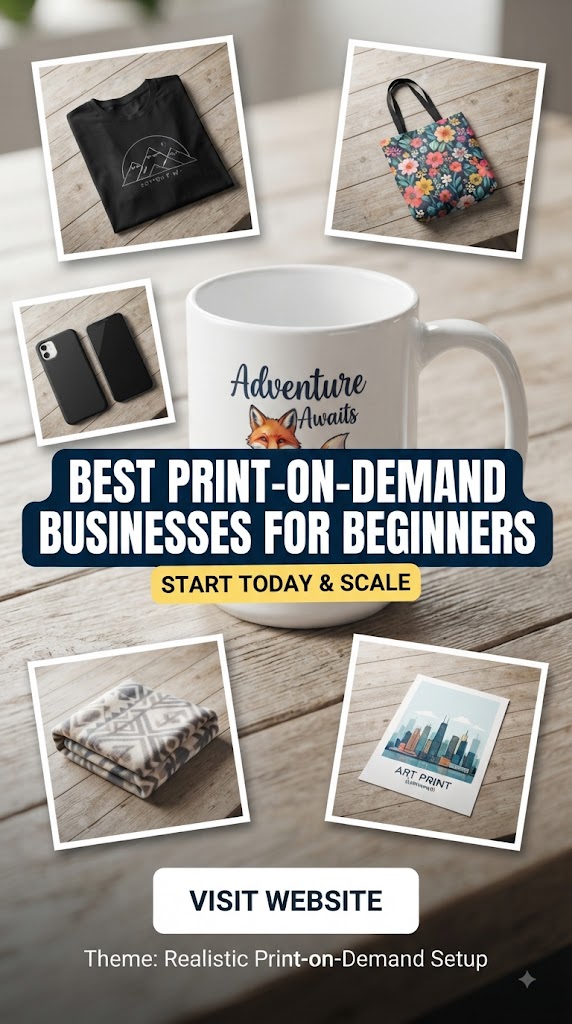
Before diving into the platforms, it is crucial to understand the mechanics. Print-on-Demand is a business model where you work with a supplier to customize white-label products (like t-shirts, mugs, or posters) with your own designs.
The “demand” part is key: you don’t pay for the product until after you’ve sold it. This eliminates the traditional barrier to entry—massive upfront costs for bulk inventory. When a customer places an order on your store, the POD provider receives the information, prints the design, and ships it directly to the customer’s doorstep. You keep the difference between what you charge the customer and what the POD provider charges you.
Why Print-on-Demand is Perfect for Beginners:
- Zero Inventory Risk: You never have to worry about unsold stock taking up space in your garage.
- Low Startup Costs: Many platforms are free to join; your primary investment is time and perhaps a small budget for marketing.
- Creative Freedom: You can test dozens of niches and designs simultaneously to see what sticks.
- Scalability: As your sales grow, your supplier handles the increased workload, allowing you to focus on marketing and design.
The Best Print-on-Demand Platforms for Beginners
Not all POD platforms are created equal. Some are “marketplaces” (where you just upload designs), while others are “fulfillers” (which you connect to your own website). Here is a breakdown of the top contenders for beginners.
1. Printful: The Gold Standard for Quality
Printful is often cited as the best all-around POD service. They own their fulfillment centers globally, which means they have tighter control over quality and shipping times.
- Why it’s great for beginners: Their interface is incredibly user-friendly, and their “Mockup Generator” is world-class, allowing you to see exactly how your design will look on a product.
- Key Products: Premium apparel, hats, jewelry, and home decor.
- Integration: Seamlessly connects with Shopify, Etsy, Wix, and WooCommerce.
- Pro Tip: Use Printful if you want to build a high-end brand where quality is your primary selling point.
2. Printify: The Best for Profit Margins
Printify operates differently than Printful. Instead of owning the factories, they are a network of printing partners. This gives you access to a massive catalog of products and competitive pricing.
- Why it’s great for beginners: Because they have multiple printers for the same product, you can choose a supplier based on price, location, or rating. This usually results in higher profit margins for you.
- Key Products: Unique items like Bluetooth speakers, pet beds, and all-over print sneakers.
- Integration: Excellent with Etsy and eBay.
- Pro Tip: Always check the “Provider Rating” on Printify to ensure you are choosing a reliable partner.
3. Redbubble: The Best for Zero-Marketing Starts
If you don’t want to build a website or learn Facebook Ads, Redbubble is your best friend. It is a massive marketplace with its own built-in traffic.
- Why it’s great for beginners: You simply upload your art, and Redbubble does the rest. They handle the storefront, the customer service, and the marketing.
- Key Products: Stickers, phone cases, and wall art.
- The Catch: Because Redbubble handles the heavy lifting, your profit margins are lower, and you don’t “own” the customer data.
- Pro Tip: Focus on “trending” tags and keywords to get found in Redbubble’s internal search engine.
4. Amazon Merch on Demand: The Power of the Giant
Amazon Merch on Demand is perhaps the most lucrative POD platform in the world because it puts your designs directly in front of Amazon’s millions of Prime members.
- Why it’s great for beginners: If your design is a hit, the volume of sales can be staggering. You don’t pay for hosting or marketing; Amazon handles everything.
- The Catch: It is invitation-only. You have to apply and wait to be accepted, and they are notoriously picky.
- Pro Tip: When applying, show a portfolio of original work and emphasize your commitment to following copyright laws.
5. Gelato: The Global Expansion Expert
Gelato is a rising star in the POD world, focusing on local production in over 30 countries.
- Why it’s great for beginners: By producing items locally to the customer, Gelato drastically reduces shipping times and carbon emissions. This is a huge selling point for eco-conscious brands.
- Key Products: High-quality wall art, stationery, and apparel.
Choosing Your Niche: The Secret Sauce of POD Success
One of the biggest mistakes beginners make is trying to sell to everyone. In the POD world, a “general store” usually fails. To succeed, you need to go deep into a specific niche.
How to Identify a Profitable Niche
A profitable niche exists at the intersection of Passion and Profitability. Ask yourself:
- Are people passionate about this (hobbies, pets, professions)?
- Do people spend money on this (golf, nursing, specialized tech)?
- Is there a specific “language” or “inside joke” associated with this niche?
High-Converting Niche Ideas for 2024:
- The “Proud Professional”: Nurses, teachers, truck drivers, and software engineers love wearing their identity.
- Pet Sub-Niches: Instead of just “Dogs,” go for “Rescue Greyhound Moms” or “Hyperactive Border Collie Owners.”
- Eco-Conscious Living: Designs focused on sustainability, veganism, or climate action.
- Hyper-Local Pride: Small towns, local landmarks, or specific neighborhood inside jokes.
- Retro/Vintage Hobbyists: Vinyl collectors, classic car enthusiasts, or retro gaming fans.
Product Selection: Beyond the T-Shirt
While t-shirts are the bread and butter of the POD industry, they are also the most competitive. To stand out as a beginner, consider diversifying your product line with these high-margin items:
1. Custom Wall Art and Posters
Wall art has a much higher perceived value than a t-shirt. A customer who might hesitate to pay $30 for a shirt will often happily pay $60-$100 for a large, high-quality canvas print.
2. Personalized Mugs
Mugs are the ultimate gift item. During the Q4 holiday season (October–December), mug sales skyrocket. They are cheap to produce and offer a high profit-per-unit ratio.
3. Embroidered Apparel
Embroidery (on hats, hoodies, or polo shirts) feels more “premium” than screen printing. It allows you to charge a higher price point and positions your brand as a boutique label rather than a bargain shop.
4. All-Over Print (AOP) Products
AOP involves printing a design across the entire fabric before it is sewn. This is perfect for patterns, galaxy prints, or bold artistic statements that a standard “rectangular” print can’t achieve.
5. Home Decor (Blankets and Pillows)
“Cozy” is a massive market. Throw blankets with personalized family names or artistic patterns are high-ticket items that perform exceptionally well on platforms like Etsy and Pinterest.
Design Strategies for Non-Artists
You do not need to be a professional illustrator to run a successful POD business. In fact, some of the best-selling designs in history are simple text-based graphics.
Use Design Tools
- Canva: The go-to tool for beginners. They have thousands of templates and a user-friendly “drag and drop” interface.
- Kittl: A powerful design tool specifically built for t-shirt and logo designers. It offers incredible typography and vintage ornaments.
- Creative Fabrica: A marketplace where you can buy “Commercial Use” fonts and graphics. You can take these elements and combine them to create unique designs.
The Power of AI in POD
Generative AI (like Midjourney or DALL-E 3) has revolutionized POD. You can now generate complex, high-resolution artwork simply by typing a prompt.
- Warning: Always check the copyright terms of the AI tool you are using and ensure the designs are unique enough to be branded as your own.
Focus on Typography
Sometimes, a clean font with a relatable quote is all you need. Focus on:
- Hierarchy: Making the most important words the largest.
- Contrast: Using colors that pop against the garment color.
- Vibe: Using a “rugged” font for a camping niche and a “curly” font for a bridal niche.
Marketing Your POD Business: From $0 to $10,000
Having a great product is only half the battle. You need to get eyes on your store. Here are the three most effective marketing channels for POD beginners.
1. Mastering Etsy SEO
If you are using Printify or Printful, connecting them to an Etsy shop is the most common path for beginners. Etsy is a search engine. To win:
- Keyword Research: Use tools like eRank or Marmalead to find what people are actually typing into the search bar.
- Long-Tail Keywords: Instead of “Funny Shirt,” use “Funny Retirement Gift for History Teacher.”
- High-Quality Mockups: Use “Lifestyle Mockups” (photos of people actually wearing the product) to stand out from the sea of flat-lay images.
2. The Power of Pinterest
Pinterest is a visual discovery engine, making it a goldmine for POD.
- Create “Pins” for every product in your store.
- Focus on aesthetic photography.
- Use “Idea Pins” to show the “behind the scenes” of your design process.
- Pinterest users are often in a “shopping mindset,” meaning they are more likely to convert than someone browsing Facebook.
3. TikTok and Instagram Reels
Short-form video is the fastest way to go viral for free.
- The “Pack an Order” Video: Even if you aren’t packing it yourself, you can show the process or the final product.
- The “Niche Call-out”: “If you’re a cat mom who also loves heavy metal, this shirt was made for you.”
- User-Generated Content (UGC): Order samples of your own products and film yourself wearing/using them. Authenticity sells.
Essential Tips for POD Success (The “Pro” Checklist)
To move from a hobbyist to a professional business owner, follow these golden rules:
- Always Order Samples: Never sell a product you haven’t seen in person. You need to verify the print quality, the fabric feel, and the shipping speed.
- Monitor Your Margins: Don’t forget to factor in the cost of the garment, shipping, platform fees (Etsy takes a cut), and marketing costs. Aim for at least a $10 profit per t-shirt.
- Understand Copyright and Trademarks: Do not use Disney characters, sports team logos, or famous song lyrics. Your store will be shut down, and you could face legal action. Use tools like the USPTO TESS database to check for trademarks.
- Focus on Customer Service: Even though you don’t ship the product, you are responsible for the customer experience. Respond to messages quickly and have a clear return policy.
- Consistency Over Intensity: It is better to upload 3 designs a week for a year than 50 designs in one day and then quit. The “algorithm” on almost every platform rewards consistency.
Common Pitfalls to Avoid
Even with the best intentions, many beginners stumble. Avoid these traps:
- The “Ghost Store” Syndrome: Launching a store and expecting sales to roll in without any marketing.
- Over-Designing: Making designs so complex they look messy when printed. Keep it clean.
- Ignoring Shipping Times: Be transparent with your customers about how long it takes to print and ship. During holidays, add a buffer to your delivery estimates.
- Pricing Too Low: Beginners often try to be the “cheapest.” This is a race to the bottom. Price for profit and focus on the value of your unique design.
Scaling Your POD Business
Once you have your first 10–20 sales, it’s time to scale.
- Automate: Use tools like Bulk Mockup or automated listing software to speed up your workflow.
- Expand Platforms: If your designs are selling on Etsy, move them to Amazon Merch or start your own Shopify store to build a mailing list.
- Hire Designers: Once you know what sells, hire freelancers on platforms like Upwork or Fiverr to create more designs in that style, allowing you to focus on high-level strategy.
- Paid Ads: When you have a “winner” (a design that converts well organically), pour gasoline on the fire by running targeted Facebook or Pinterest ads.
Final Thoughts: The Journey Starts Today
The Print-on-Demand business model is a marathon, not a sprint. It requires a blend of creative experimentation, data-driven decision-making, and persistent marketing. However, the reward—a semi-automated business that generates income while you sleep—is well worth the effort.
The barriers to entry have never been lower. With platforms like Printful and Printify handling the heavy lifting, and marketplaces like Etsy and Redbubble providing the customers, your only job is to bring the ideas.
Choose a niche you care about, create your first design, and launch your store. You don’t have to be great to start, but you have to start to be great. The world of Print-on-Demand is waiting for your unique vision. What will you create today?