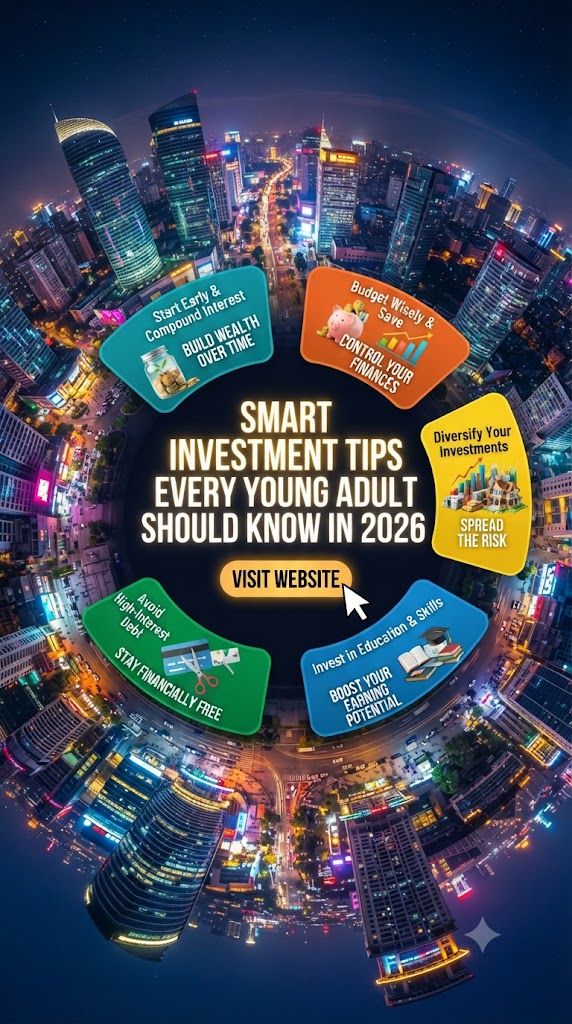
Master Your Future: The Ultimate Guide to Smart Investing for Young Adults
The financial landscape for young adults today is vastly different than it was for previous generations. We live in an era of instant gratification, volatile markets, and an overwhelming amount of information. However, one fundamental truth remains: Time is your most valuable asset.
If you are in your 20s or early 30s, you possess a mathematical advantage that even the world’s wealthiest billionaires cannot buy back. This guide is designed to help you harness that power, navigate the complexities of the market, and build a foundation for lifelong wealth. Whether you’re working your first entry-level job or you’re a few years into your career, these smart investment tips will set you on the path to financial independence.
1. The Psychology of Wealth: Shifting Your Mindset
Before you open a brokerage account or buy your first share of stock, you must address the “software” running your financial decisions: your mindset.
The Power of Compounding
Albert Einstein reportedly called compound interest the “eighth wonder of the world.” For a young adult, compounding is the process where your earnings earn more earnings.
Imagine two investors:
- Investor A starts at age 20, investing $500 a month for 10 years, then stops entirely at age 30.
- Investor B starts at age 30 and invests $500 a month every single month until age 65.
Despite Investor B putting in significantly more money over 35 years, Investor A will likely end up with a larger portfolio simply because those early dollars had an extra decade to compound. The lesson? Start now, even if it’s a small amount.
Overcoming the “YOLO” and “FOMO” Trap
Social media creates a distorted reality where everyone seems to be getting rich off “meme coins” or luxury dropshipping. Real investing is often boring. It’s the consistent, disciplined accumulation of productive assets. Smart investors don’t chase “moon shots”; they build systems that ensure long-term success.
2. The Pre-Investment Checklist: Building the Foundation
You cannot build a skyscraper on a swamp. Before you dive into the stock market, you must secure your financial perimeter.
Step 1: Kill High-Interest Debt
Investing while carrying credit card debt is like trying to swim with a lead weight. If your credit card charges 20% interest and the stock market historically returns 10%, you are losing 10% of your net worth every year you don’t pay off that card. Prioritize any debt with an interest rate higher than 7-8%.
Step 2: The Emergency Fund
Life happens. Cars break down, layoffs occur, and medical emergencies arise. Without an emergency fund, you will be forced to sell your investments at the worst possible time (during a market downturn) to cover costs. Aim for 3 to 6 months of essential living expenses in a high-yield savings account (HYSA).
Step 3: Understand Your Cash Flow
You can’t invest what you don’t have. Use the 50/30/20 Rule as a baseline:
- 50% for Needs (Rent, groceries, utilities).
- 30% for Wants (Dining out, hobbies, Netflix).
- 20% for Savings and Investing.
If you can push that 20% higher, your future self will thank you.
3. Demystifying Asset Classes: Where to Put Your Money
Investing is essentially buying “machines” that produce money. Here are the primary machines available to you:
Stocks (Equities)
When you buy a stock, you own a piece of a corporation. Stocks offer the highest historical returns but come with “volatility”—the price will go up and down daily. As a young adult, you should be heavily weighted in stocks because you have the time to ride out the market’s inevitable dips.
Bonds (Fixed Income)
Bonds are essentially loans you provide to a government or corporation in exchange for interest payments. They are generally safer than stocks but offer lower returns. They act as the “ballast” on your ship, keeping you steady when the stock market gets stormy.
Index Funds and ETFs
For 99% of young adults, picking individual stocks is a losing game. Even professional hedge fund managers struggle to beat the market.
- Index Funds: These allow you to buy the entire market (like the S&P 500) in one go.
- ETFs (Exchange Traded Funds): Similar to index funds but traded like individual stocks. They are low-cost, tax-efficient, and provide instant diversification.
Real Estate
You don’t need a million dollars to invest in real estate. You can start with REITs (Real Estate Investment Trusts), which are companies that own income-producing real estate. They pay out dividends and allow you to benefit from property appreciation without having to fix a leaky toilet.
Alternative Investments (Crypto, Commodities, Art)
These should represent a small “satellite” portion of your portfolio (typically 1-5%). While Bitcoin and Ethereum have shown massive growth, they are highly speculative. Never invest money in “alts” that you aren’t prepared to lose entirely.
4. The Golden Rule: Diversification
The only “free lunch” in investing is diversification. If you put all your money into one tech stock and that company collapses, you lose everything. If you invest in a Total Stock Market Index Fund, you own 3,000+ companies. For you to lose everything, the entire global economy would have to cease to exist.
Asset Allocation by Age
A classic rule of thumb is “110 minus your age” equals the percentage of your portfolio that should be in stocks.
- If you are 25: 110 – 25 = 85% in stocks, 15% in bonds/cash.
- As you get older, you slowly shift toward bonds to protect your capital.
5. Tax-Advantaged Accounts: The Secret Weapon
The government offers special accounts to encourage you to save for retirement. Understanding these is the difference between retiring “okay” and retiring wealthy.
The 401(k) and the “Employer Match”
If your employer offers a 401(k) match, that is a 100% return on your money instantly. If they match up to 4% of your salary, and you don’t contribute, you are literally leaving free money on the table. Always contribute enough to get the full match.
The Roth IRA: The Young Adult’s Best Friend
The Roth IRA is a masterpiece of financial engineering for young people.
- You pay taxes on the money now.
- The money grows tax-free.
- You pay zero taxes when you withdraw it in retirement. Since you are likely in a lower tax bracket now than you will be in 30 years, paying the tax today is a massive bargain.
The HSA (Health Savings Account)
Often overlooked, the HSA is a “triple-tax-advantaged” account.
- Contributions are tax-deductible.
- Growth is tax-free.
- Withdrawals for medical expenses are tax-free. After age 65, you can withdraw money for anything (taxed as income), making it a “stealth IRA.”
6. Investment Strategies for Long-Term Success
Dollar-Cost Averaging (DCA)
Don’t wait for the “perfect time” to buy. Market timing is a myth. Instead, use Dollar-Cost Averaging: invest a fixed amount of money every month regardless of whether the market is up or down.
- When prices are high, your dollars buy fewer shares.
- When prices are low, your dollars buy more shares. Over time, this lowers your average cost per share and removes the emotional stress of watching the charts.
The “Bogleheads” Approach: Low Fees
High fees are the silent killers of wealth. If your mutual fund charges a 1% management fee and an index fund charges 0.05%, that 0.95% difference could cost you hundreds of thousands of dollars over 40 years. Always look for the “Expense Ratio.” Anything over 0.50% for a standard fund should be questioned.
Rebalancing Your Portfolio
Once a year, look at your target allocation. If your stocks performed so well that they now make up 95% of your portfolio (instead of your target 85%), sell some stocks and buy bonds. This forces you to “buy low and sell high” automatically.
7. The Role of Technology: Fintech and Robo-Advisors
We live in the golden age of financial accessibility. You no longer need a suit-and-tie broker to manage your money.
- Robo-Advisors (Betterment, Wealthfront): Excellent for those who want a “set it and forget it” approach. They use algorithms to manage your diversification and rebalancing for a small fee.
- Zero-Commission Brokers (Vanguard, Fidelity, Charles Schwab): These are the titans of the industry. They offer incredible tools and nearly free access to the world’s best index funds.
- Micro-Investing Apps (Acorns, Stash): Good for building the habit of saving “spare change,” but eventually, you should move toward more robust platforms to minimize fees.
8. Common Pitfalls to Avoid
1. Waiting for the “Crash”
Many young adults stay on the sidelines waiting for a market correction. Meanwhile, the market climbs 20%. Even if a crash happens, you’ve missed out on the gains that would have cushioned the blow. Time in the market beats timing the market.
2. Checking Your Portfolio Daily
The stock market is a device for transferring money from the impatient to the patient. If you check your balance every day, you will eventually make an emotional decision based on short-term noise. Check it quarterly or yearly.
3. Lifestyle Creep
As you get raises and promotions, it’s tempting to upgrade your car, your apartment, and your wardrobe. This is “Lifestyle Creep.” If you can maintain your current standard of living while investing your raises, you will reach financial freedom decades ahead of your peers.
4. Ignoring Inflation
If your money is sitting in a traditional savings account earning 0.01% interest, you are losing purchasing power every year due to inflation. Investing isn’t just about getting rich; it’s about protecting your labor from being eroded by the rising cost of goods.
9. Investing in “Human Capital”
The most important asset you will ever manage is yourself.
For a 22-year-old, the potential future earnings from your career far outweigh the $1,000 you have in a brokerage account.
- Skill Acquisition: Spend money on certifications, books, and courses that increase your earning potential.
- Networking: Relationships are a form of social equity. Who you know often determines the opportunities you get.
- Health: You can’t enjoy wealth if you are burnt out or chronically ill. Invest in good food, sleep, and exercise.
10. A Step-by-Step Action Plan for the Next 30 Days
To turn this knowledge into wealth, you need to take action. Follow this roadmap:
Week 1: Audit and Automate
- Track every cent you spent last month.
- Identify “leaks” (unused subscriptions, excessive takeout).
- Set up an automatic transfer from your checking to a high-yield savings account for your emergency fund.
Week 2: Capture the Match
- Log into your employer’s HR portal.
- Sign up for the 401(k).
- Set your contribution to at least the “match” level.
- Crucial: Ensure the money is actually being invested in a target-date fund or S&P 500 index fund, not just sitting in a “settlement fund” (cash).
Week 3: Open a Roth IRA
- Go to Vanguard, Fidelity, or Schwab.
- Open a Roth IRA.
- Set up a recurring monthly contribution (even if it’s just $50).
- Choose a “Total Stock Market” index fund (like VTI or VTSAX).
Week 4: Education and Review
- Read one classic investment book (e.g., The Simple Path to Wealth by JL Collins or The Psychology of Money by Morgan Housel).
- Set a calendar reminder for 6 months from now to review your progress.
11. Conclusion: The Long Game
Smart investing isn’t about finding the next “hot” stock or getting lucky on a crypto pump. It is about the disciplined execution of a simple plan over a long period.
As a young adult, the world is quite literally yours for the taking. By avoiding debt, utilizing tax-advantaged accounts, and embracing the power of compound interest, you are building a “wealth machine” that will work for you while you sleep, while you travel, and eventually, while you enjoy a comfortable retirement.
The best time to start was ten years ago. The second best time is today. Stop overthinking, start automating, and let time do the heavy lifting. Your future self will look back at this moment as the turning point that changed your life forever.
Summary Checklist for Success:
- Emergency Fund: Do I have 3 months of cash?
- High-Interest Debt: Is my credit card balance zero?
- Employer Match: Am I getting my free 401(k) money?
- Roth IRA: Is my tax-free growth account active?
- Automation: Is my investing happening without me thinking about it?
- Diversification: Do I own the whole market or just a few risky stocks?
Investing is a marathon, not a sprint. Pace yourself, stay informed, and stay the course.