The $100 Startup: 10 Profitable Online Businesses You Can Launch Today
If you have $100 in your pocket and a laptop, you have enough to build a digital empire. The secret lies in “sweat equity”—trading your time and focus for financial growth until the business can sustain itself. By leveraging low-cost tools and global platforms, you can bypass the traditional gatekeepers of commerce.
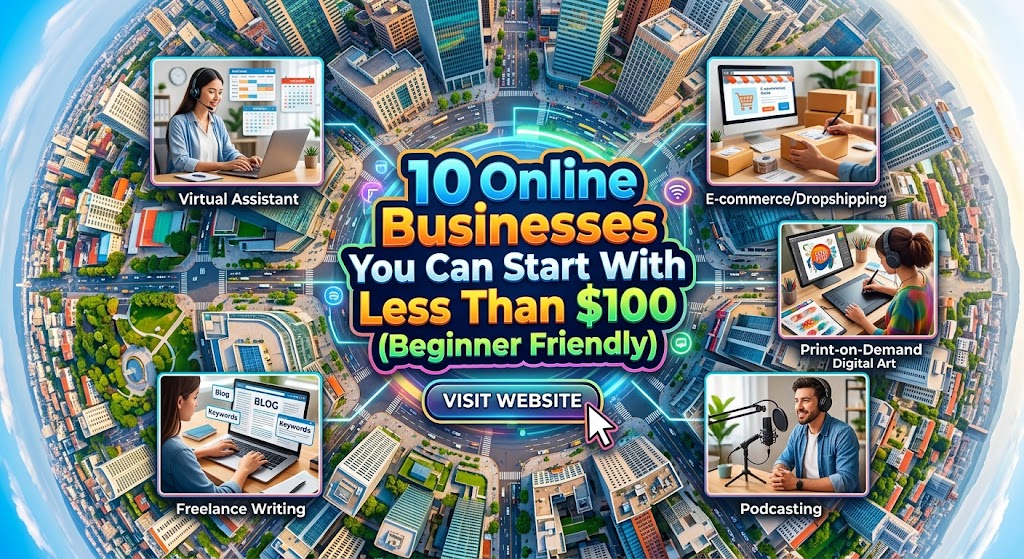
Here are 10 online businesses you can start for under $100, detailed with step-by-step strategies to go from zero to your first $1,000 and beyond.
1. Freelance Content Writing and Copywriting
Every single pixel on the internet requires words. From the product description of a specialized surgical tool to the viral thread you read on X (formerly Twitter), businesses are starving for high-quality content.
Why It Works
Companies are shifting away from massive in-house marketing teams and moving toward agile freelancers. As a writer, you are solving a fundamental problem: helping businesses communicate their value to customers.
The $100 Budget Breakdown
- Domain Name: $12 (via Namecheap or Google Domains).
- Basic Portfolio Website: $40 (One year of basic hosting or a Carrd.co pro site).
- Professional Email: $6/month (Google Workspace).
- Grammarly Premium (Optional): Use the free version until you land your first client.
- Remaining: $42 for LinkedIn Premium or niche-specific books.
Strategy for Success
Don’t be a “generalist.” Generalists get paid pennies. Instead, become a “SaaS Whitepaper Writer” or a “Direct Response Copywriter for E-commerce.” Pick a niche where the average customer value is high. Create three “spec” pieces (samples written for imaginary clients) and host them on your site. Use LinkedIn to find Marketing Managers and offer a “First Article Discount” to build your testimonial base.
2. Virtual Assistant (VA) Services for Specialized Niches
Modern entrepreneurs are “solopreneurs”—they run multi-million dollar businesses alone. Eventually, they hit a ceiling. They need someone to manage their inbox, schedule their podcasts, and handle customer queries.
Why It Works
A VA isn’t just a secretary; they are an operations partner. By taking low-level tasks off an owner’s plate, you are literally buying them time, which makes you incredibly valuable.
The $100 Budget Breakdown
- Canva Pro: $12/month (to create professional reports and social posts for clients).
- Calendly Pro: $12/month (to manage complex scheduling).
- Task Management Tool: $0 (Trello or Notion).
- Networking/Cold Outreach: $76 remaining for LinkedIn Sales Navigator or niche community memberships.
Strategy for Success
Focus on “High-Value VAs.” Instead of offering general data entry, offer “Podcast Management” (editing, booking guests, and distribution) or “Executive Inbox Management.” Specializing in a specific software (like HighLevel or Salesforce) allows you to charge $50+/hour instead of $15/hour.
3. Niche Blogging and Affiliate Marketing
Blogging is not dead; it has simply evolved. People no longer read “online diaries,” but they do search for answers to specific problems. A niche blog serves as an authority hub that generates income while you sleep through affiliate links and display ads.
Why It Works
You are building a digital asset. Unlike freelancing, where you stop getting paid when you stop working, a blog post written today can generate revenue for years.
The $100 Budget Breakdown
- Domain Name: $12.
- Shared Hosting: $60 (One year of Bluehost or SiteGround).
- WordPress Theme: $0 (Use Astra or GeneratePress).
- Keyword Research Tools: $0 (Use Google Keyword Planner and AnswerThePublic).
- Remaining: $28 for stock imagery or basic plugins.
Strategy for Success
Find a “low competition, high intent” niche. Instead of “Fitness,” try “Home Gym Equipment for Small Apartments.” Use SEO (Search Engine Optimization) to rank for specific questions like “Best foldable treadmill for studio apartments.” Once you have traffic, join the Amazon Associates program or specialized affiliate networks to earn commissions on products you recommend.
4. Print on Demand (POD)
Print on Demand allows you to sell custom-designed apparel, mugs, and posters without ever touching the inventory. When a customer buys a shirt from your store, a third-party provider (like Printful or Printify) prints and ships it for you.
Why It Works
You have zero inventory risk. You only pay for the product after the customer has already paid you. Your primary job is design and marketing.
The $100 Budget Breakdown
- Etsy Listing Fees: $20 (approx. 100 listings at $0.20 each).
- Canva Pro: $12/month (essential for high-quality designs).
- Sample Products: $40 (to test quality and take custom photos).
- Remaining: $28 for social media ads or aesthetic mockups.
Strategy for Success
The “Generic T-shirt” market is saturated. The “Specific Hobby” market is a goldmine. Design for “Vintage Japanese Motorcycle Enthusiasts” or “Introverted Bookkeepers.” Use TikTok and Pinterest to showcase your designs. Trends move fast; use tools like Google Trends to see what’s rising and create designs around those themes.
5. Online Tutoring and Language Coaching
If you have a skill or speak a language fluently, you have a product. The global e-learning market is projected to reach $450 billion by 2026.
Why It Works
Trust is the new currency. People would rather learn from a real human over Zoom than a faceless corporation.
The $100 Budget Breakdown
- Zoom Pro: $15/month (for sessions longer than 40 minutes).
- Professional Headshot: $0 (Use a modern smartphone and natural light).
- Booking Software: $0 (Use the free version of Calendly).
- Microphone: $50 (A decent USB mic like the Blue Snowball ensures professional audio).
- Remaining: $35 for Facebook Group marketing or LinkedIn outreach.
Strategy for Success
Don’t just teach “English.” Teach “Business English for Tech Executives in Brazil.” By narrowing your audience, you can charge premium rates. Use platforms like Preply or Italki to get your first students, then move them to your own platform to avoid high commission fees.
6. Social Media Management and Growth Hacking
Small business owners know they need to be on TikTok, Instagram, and LinkedIn, but they are often overwhelmed by the sheer volume of content required.
Why It Works
Consistency is the hardest part of social media. If you can provide a month’s worth of content, scheduling, and engagement, you are an indispensable asset to a business.
The $100 Budget Breakdown
- Scheduling Tool: $15/month (Later or Buffer).
- Content Creation: $12/month (Canva Pro).
- Portfolio: $0 (Use your own social media channels as a case study).
- Remaining: $73 for educational courses on the latest algorithm changes (e.g., TikTok SEO).
Strategy for Success
Focus on “Short-Form Video.” Every business is currently desperate for Reels and TikToks. Offer a “Starter Package” where you take their long-form content (like podcasts or blogs) and turn them into 15 viral clips. This “content repurposing” is one of the highest-demand services in the current market.
7. Digital Product Creation (Templates and E-books)
Digital products are the “holy grail” of online business. You build it once and sell it an infinite number of times with 100% profit margins (minus platform fees).
Why It Works
Low overhead and high scalability. Whether it’s a Notion template for project management or an e-book on “How to Start a Backyard Chicken Coop,” digital products solve specific problems instantly.
The $100 Budget Breakdown
- Selling Platform: $0 (Gumroad, Stan Store, or Etsy).
- Design Tools: $12/month (Canva Pro).
- Domain for Landing Page: $12.
- Email Marketing: $0 (Mailchimp or ConvertKit free tiers).
- Remaining: $76 for targeted social media ads or “Shoutouts” from small influencers.
Strategy for Success
Solve a “pain point” you have personally experienced. If you spent months perfecting a budget spreadsheet, others will pay $15 to skip the work and use yours. The key is the “Lead Magnet”—give away a small part of the solution for free to build an email list, then upsell the full product.
8. Lean Dropshipping (The “Organic” Way)
Traditional dropshipping failed because people spent thousands on Facebook ads for low-quality products. “Lean” dropshipping focuses on high-quality, viral products marketed through organic social media content.
Why It Works
You act as a curator. By finding unique products and creating engaging video content, you drive traffic without the traditional “Ad Spend” risk.
The $100 Budget Breakdown
- Shopify Basic: $39/month (often $1/month for the first 3 months during promotions).
- Domain Name: $12.
- Product Samples: $40 (Essential for filming your own content).
- Remaining: $9 for basic editing apps like CapCut (Pro version).
Strategy for Success
Pick “Problem-Solver” products. A “pet hair remover” is better than a “cool watch” because the hair remover solves a visible, frustrating problem. Order the product to your house, film 50 different TikToks/Reels using it, and link your store in the bio. If one video goes viral, your business is born overnight.
9. Specialized Graphic Design (Canva-Based or Pro)
You don’t need a Master’s degree in Fine Arts to be a graphic designer in the 2020s. You need an eye for branding and a mastery of modern tools.
Why It Works
Every new business needs a logo, social media assets, and pitch decks. Most business owners have the vision but lack the technical skill to make it look “professional.”
The $100 Budget Breakdown
- Canva Pro or Adobe Creative Cloud (Single App): $12-$20/month.
- Portfolio Site: $0 (Behance or Adobe Portfolio).
- Font/Asset Packs: $30 (Creative Market).
- Remaining: $50 for a professional logo for your brand and some LinkedIn marketing.
Strategy for Success
Niche down into “YouTube Thumbnails” or “Pitch Decks for Startups.” High-level YouTubers will pay hundreds of dollars for a single thumbnail if it increases their click-through rate (CTR) by 2%. It’s about ROI (Return on Investment), not just “pretty pictures.”
10. Online Membership or Micro-Community
People are lonelier than ever and are looking for “tribes.” A micro-community is a paid group where members get access to you and a network of like-minded individuals.
Why It Works
Recurring revenue. Instead of hunting for new clients every month, you provide ongoing value to a dedicated group of subscribers.
The $100 Budget Breakdown
- Community Platform: $0-$39/month (Discord is free; platforms like Circle or Skool have monthly fees).
- Landing Page: $12 (Domain).
- Email Service: $0 (Substack is a great free option for memberships).
- Remaining: $49 for content research or guest speakers.
Strategy for Success
Start with a “Beta Group.” Invite 10 people to join for a low monthly fee ($10/month) in exchange for their feedback. Use their testimonials to launch to a larger audience at $29 or $49/month. The value isn’t just in your knowledge; it’s in the connections the members make with each other.
The Secret Sauce: Scaling Beyond $100
Starting for under $100 is the easy part. Growing that business into a full-time income requires a specific mindset and operational framework.
1. Reinvest Every Penny
For the first six months, do not take a “salary.” If you make $500, put that $500 back into the business. Buy better software, hire a part-time editor, or start spending on targeted ads. This “compounding” effect is what separates hobbies from businesses.
2. Master the Art of Outreach
You can have the best product in the world, but if no one knows about it, you have a secret, not a business. Spend 20% of your time creating and 80% of your time promoting. Cold emails, LinkedIn networking, and guest posting are free but require high effort.
3. Focus on “High-Leverage” Activities
As your business grows, you will get bogged down in administrative tasks. Always ask yourself: “Is this a $10/hour task or a $1,000/hour task?” Managing your inbox is $10/hour. Closing a new client or creating a new product is $1,000/hour. Outsource the low-value tasks as soon as you can afford it.
4. Build a Personal Brand
In the age of AI, “Human Connection” is a premium. Whether you are a writer or a dropshipper, building a personal brand on LinkedIn or X makes you “uncopyable.” People buy from people they know, like, and trust.
Common Pitfalls to Avoid
Even with a low-cost startup, there are traps that can sink you before you get started:
- The “Perfect Website” Trap: Do not spend three weeks picking a font. Your website just needs to be functional and clean. Your revenue comes from sales, not your “About Me” page.
- Shiny Object Syndrome: Pick one of the ten businesses above and stick with it for at least six months. Most people fail because they quit right before the “inflection point” where growth becomes exponential.
- Ignoring Data: Use analytics. If you’re blogging, look at what’s ranking. If you’re selling on Etsy, look at what’s being favorited. Let the market tell you what it wants.
Conclusion: Your $100 Legacy
The $100 startup isn’t just about the money. It’s about the psychological shift from being a consumer to being a creator. It’s about realizing that you don’t need permission to build something.
The tools are free. The information is available. The only variable left is you. If you can dedicate two hours a day to one of these models, you aren’t just starting an online business—you are designing a life of autonomy and financial freedom.
Which one will you start today? The clock is ticking, and the internet is waiting.The $100 Startup: 10 Profitable Online Businesses You Can Launch Today
The age-old myth that you need a massive inheritance, a venture capital injection, or a secondary mortgage to start a business is officially dead. We are living in the most democratized era of entrepreneurship in human history. Today, the barrier to entry isn’t capital; it’s courage, consistency, and a high-speed internet connection.
If you have $100 in your pocket and a laptop, you have enough to build a digital empire. The secret lies in “sweat equity”—trading your time and focus for financial growth until the business can sustain itself. By leveraging low-cost tools and global platforms, you can bypass the traditional gatekeepers of commerce.
Here are 10 online businesses you can start for under $100, detailed with step-by-step strategies to go from zero to your first $1,000 and beyond.
1. Freelance Content Writing and Copywriting
Every single pixel on the internet requires words. From the product description of a specialized surgical tool to the viral thread you read on X (formerly Twitter), businesses are starving for high-quality content.
Why It Works
Companies are shifting away from massive in-house marketing teams and moving toward agile freelancers. As a writer, you are solving a fundamental problem: helping businesses communicate their value to customers.
The $100 Budget Breakdown
- Domain Name: $12 (via Namecheap or Google Domains).
- Basic Portfolio Website: $40 (One year of basic hosting or a Carrd.co pro site).
- Professional Email: $6/month (Google Workspace).
- Grammarly Premium (Optional): Use the free version until you land your first client.
- Remaining: $42 for LinkedIn Premium or niche-specific books.
Strategy for Success
Don’t be a “generalist.” Generalists get paid pennies. Instead, become a “SaaS Whitepaper Writer” or a “Direct Response Copywriter for E-commerce.” Pick a niche where the average customer value is high. Create three “spec” pieces (samples written for imaginary clients) and host them on your site. Use LinkedIn to find Marketing Managers and offer a “First Article Discount” to build your testimonial base.
2. Virtual Assistant (VA) Services for Specialized Niches
Modern entrepreneurs are “solopreneurs”—they run multi-million dollar businesses alone. Eventually, they hit a ceiling. They need someone to manage their inbox, schedule their podcasts, and handle customer queries.
Why It Works
A VA isn’t just a secretary; they are an operations partner. By taking low-level tasks off an owner’s plate, you are literally buying them time, which makes you incredibly valuable.
The $100 Budget Breakdown
- Canva Pro: $12/month (to create professional reports and social posts for clients).
- Calendly Pro: $12/month (to manage complex scheduling).
- Task Management Tool: $0 (Trello or Notion).
- Networking/Cold Outreach: $76 remaining for LinkedIn Sales Navigator or niche community memberships.
Strategy for Success
Focus on “High-Value VAs.” Instead of offering general data entry, offer “Podcast Management” (editing, booking guests, and distribution) or “Executive Inbox Management.” Specializing in a specific software (like HighLevel or Salesforce) allows you to charge $50+/hour instead of $15/hour.
3. Niche Blogging and Affiliate Marketing
Blogging is not dead; it has simply evolved. People no longer read “online diaries,” but they do search for answers to specific problems. A niche blog serves as an authority hub that generates income while you sleep through affiliate links and display ads.
Why It Works
You are building a digital asset. Unlike freelancing, where you stop getting paid when you stop working, a blog post written today can generate revenue for years.
The $100 Budget Breakdown
- Domain Name: $12.
- Shared Hosting: $60 (One year of Bluehost or SiteGround).
- WordPress Theme: $0 (Use Astra or GeneratePress).
- Keyword Research Tools: $0 (Use Google Keyword Planner and AnswerThePublic).
- Remaining: $28 for stock imagery or basic plugins.
Strategy for Success
Find a “low competition, high intent” niche. Instead of “Fitness,” try “Home Gym Equipment for Small Apartments.” Use SEO (Search Engine Optimization) to rank for specific questions like “Best foldable treadmill for studio apartments.” Once you have traffic, join the Amazon Associates program or specialized affiliate networks to earn commissions on products you recommend.
4. Print on Demand (POD)
Print on Demand allows you to sell custom-designed apparel, mugs, and posters without ever touching the inventory. When a customer buys a shirt from your store, a third-party provider (like Printful or Printify) prints and ships it for you.
Why It Works
You have zero inventory risk. You only pay for the product after the customer has already paid you. Your primary job is design and marketing.
The $100 Budget Breakdown
- Etsy Listing Fees: $20 (approx. 100 listings at $0.20 each).
- Canva Pro: $12/month (essential for high-quality designs).
- Sample Products: $40 (to test quality and take custom photos).
- Remaining: $28 for social media ads or aesthetic mockups.
Strategy for Success
The “Generic T-shirt” market is saturated. The “Specific Hobby” market is a goldmine. Design for “Vintage Japanese Motorcycle Enthusiasts” or “Introverted Bookkeepers.” Use TikTok and Pinterest to showcase your designs. Trends move fast; use tools like Google Trends to see what’s rising and create designs around those themes.
5. Online Tutoring and Language Coaching
If you have a skill or speak a language fluently, you have a product. The global e-learning market is projected to reach $450 billion by 2026.
Why It Works
Trust is the new currency. People would rather learn from a real human over Zoom than a faceless corporation.
The $100 Budget Breakdown
- Zoom Pro: $15/month (for sessions longer than 40 minutes).
- Professional Headshot: $0 (Use a modern smartphone and natural light).
- Booking Software: $0 (Use the free version of Calendly).
- Microphone: $50 (A decent USB mic like the Blue Snowball ensures professional audio).
- Remaining: $35 for Facebook Group marketing or LinkedIn outreach.
Strategy for Success
Don’t just teach “English.” Teach “Business English for Tech Executives in Brazil.” By narrowing your audience, you can charge premium rates. Use platforms like Preply or Italki to get your first students, then move them to your own platform to avoid high commission fees.
6. Social Media Management and Growth Hacking
Small business owners know they need to be on TikTok, Instagram, and LinkedIn, but they are often overwhelmed by the sheer volume of content required.
Why It Works
Consistency is the hardest part of social media. If you can provide a month’s worth of content, scheduling, and engagement, you are an indispensable asset to a business.
The $100 Budget Breakdown
- Scheduling Tool: $15/month (Later or Buffer).
- Content Creation: $12/month (Canva Pro).
- Portfolio: $0 (Use your own social media channels as a case study).
- Remaining: $73 for educational courses on the latest algorithm changes (e.g., TikTok SEO).
Strategy for Success
Focus on “Short-Form Video.” Every business is currently desperate for Reels and TikToks. Offer a “Starter Package” where you take their long-form content (like podcasts or blogs) and turn them into 15 viral clips. This “content repurposing” is one of the highest-demand services in the current market.
7. Digital Product Creation (Templates and E-books)
Digital products are the “holy grail” of online business. You build it once and sell it an infinite number of times with 100% profit margins (minus platform fees).
Why It Works
Low overhead and high scalability. Whether it’s a Notion template for project management or an e-book on “How to Start a Backyard Chicken Coop,” digital products solve specific problems instantly.
The $100 Budget Breakdown
- Selling Platform: $0 (Gumroad, Stan Store, or Etsy).
- Design Tools: $12/month (Canva Pro).
- Domain for Landing Page: $12.
- Email Marketing: $0 (Mailchimp or ConvertKit free tiers).
- Remaining: $76 for targeted social media ads or “Shoutouts” from small influencers.
Strategy for Success
Solve a “pain point” you have personally experienced. If you spent months perfecting a budget spreadsheet, others will pay $15 to skip the work and use yours. The key is the “Lead Magnet”—give away a small part of the solution for free to build an email list, then upsell the full product.
8. Lean Dropshipping (The “Organic” Way)
Traditional dropshipping failed because people spent thousands on Facebook ads for low-quality products. “Lean” dropshipping focuses on high-quality, viral products marketed through organic social media content.
Why It Works
You act as a curator. By finding unique products and creating engaging video content, you drive traffic without the traditional “Ad Spend” risk.
The $100 Budget Breakdown
- Shopify Basic: $39/month (often $1/month for the first 3 months during promotions).
- Domain Name: $12.
- Product Samples: $40 (Essential for filming your own content).
- Remaining: $9 for basic editing apps like CapCut (Pro version).
Strategy for Success
Pick “Problem-Solver” products. A “pet hair remover” is better than a “cool watch” because the hair remover solves a visible, frustrating problem. Order the product to your house, film 50 different TikToks/Reels using it, and link your store in the bio. If one video goes viral, your business is born overnight.
9. Specialized Graphic Design (Canva-Based or Pro)
You don’t need a Master’s degree in Fine Arts to be a graphic designer in the 2020s. You need an eye for branding and a mastery of modern tools.
Why It Works
Every new business needs a logo, social media assets, and pitch decks. Most business owners have the vision but lack the technical skill to make it look “professional.”
The $100 Budget Breakdown
- Canva Pro or Adobe Creative Cloud (Single App): $12-$20/month.
- Portfolio Site: $0 (Behance or Adobe Portfolio).
- Font/Asset Packs: $30 (Creative Market).
- Remaining: $50 for a professional logo for your brand and some LinkedIn marketing.
Strategy for Success
Niche down into “YouTube Thumbnails” or “Pitch Decks for Startups.” High-level YouTubers will pay hundreds of dollars for a single thumbnail if it increases their click-through rate (CTR) by 2%. It’s about ROI (Return on Investment), not just “pretty pictures.”
10. Online Membership or Micro-Community
People are lonelier than ever and are looking for “tribes.” A micro-community is a paid group where members get access to you and a network of like-minded individuals.
Why It Works
Recurring revenue. Instead of hunting for new clients every month, you provide ongoing value to a dedicated group of subscribers.
The $100 Budget Breakdown
- Community Platform: $0-$39/month (Discord is free; platforms like Circle or Skool have monthly fees).
- Landing Page: $12 (Domain).
- Email Service: $0 (Substack is a great free option for memberships).
- Remaining: $49 for content research or guest speakers.
Strategy for Success
Start with a “Beta Group.” Invite 10 people to join for a low monthly fee ($10/month) in exchange for their feedback. Use their testimonials to launch to a larger audience at $29 or $49/month. The value isn’t just in your knowledge; it’s in the connections the members make with each other.
The Secret Sauce: Scaling Beyond $100
Starting for under $100 is the easy part. Growing that business into a full-time income requires a specific mindset and operational framework.
1. Reinvest Every Penny
For the first six months, do not take a “salary.” If you make $500, put that $500 back into the business. Buy better software, hire a part-time editor, or start spending on targeted ads. This “compounding” effect is what separates hobbies from businesses.
2. Master the Art of Outreach
You can have the best product in the world, but if no one knows about it, you have a secret, not a business. Spend 20% of your time creating and 80% of your time promoting. Cold emails, LinkedIn networking, and guest posting are free but require high effort.
3. Focus on “High-Leverage” Activities
As your business grows, you will get bogged down in administrative tasks. Always ask yourself: “Is this a $10/hour task or a $1,000/hour task?” Managing your inbox is $10/hour. Closing a new client or creating a new product is $1,000/hour. Outsource the low-value tasks as soon as you can afford it.
4. Build a Personal Brand
In the age of AI, “Human Connection” is a premium. Whether you are a writer or a dropshipper, building a personal brand on LinkedIn or X makes you “uncopyable.” People buy from people they know, like, and trust.
Common Pitfalls to Avoid
Even with a low-cost startup, there are traps that can sink you before you get started:
- The “Perfect Website” Trap: Do not spend three weeks picking a font. Your website just needs to be functional and clean. Your revenue comes from sales, not your “About Me” page.
- Shiny Object Syndrome: Pick one of the ten businesses above and stick with it for at least six months. Most people fail because they quit right before the “inflection point” where growth becomes exponential.
- Ignoring Data: Use analytics. If you’re blogging, look at what’s ranking. If you’re selling on Etsy, look at what’s being favorited. Let the market tell you what it wants.
Conclusion: Your $100 Legacy
The $100 startup isn’t just about the money. It’s about the psychological shift from being a consumer to being a creator. It’s about realizing that you don’t need permission to build something.
The tools are free. The information is available. The only variable left is you. If you can dedicate two hours a day to one of these models, you aren’t just starting an online business—you are designing a life of autonomy and financial freedom.
Which one will you start today? The clock is ticking, and the internet is waiting.