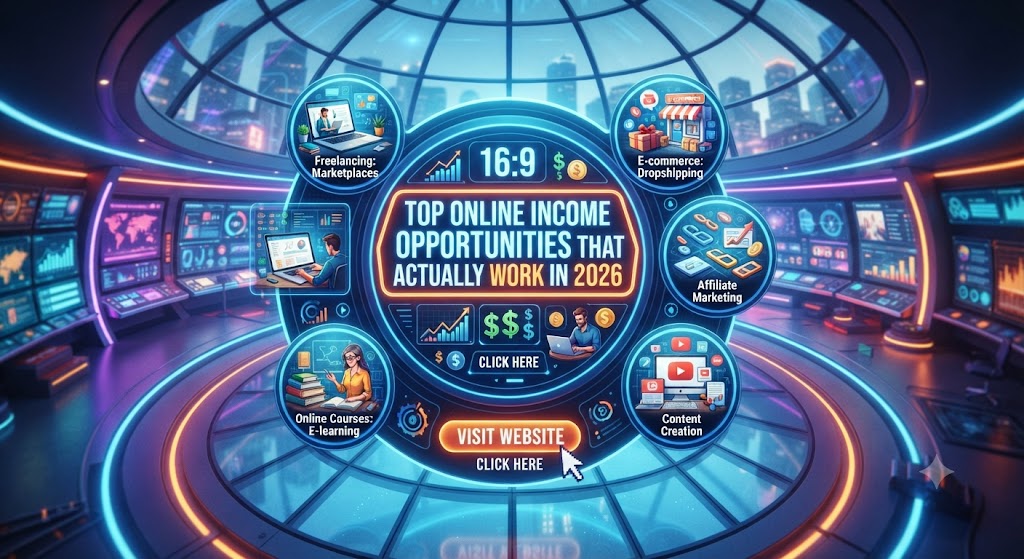
Top Online Income Opportunities That Actually Pay
The dream of earning a living from a laptop, seated in a sun-drenched café or a cozy home office, has transitioned from a niche fantasy to a mainstream reality. However, as the “work from anywhere” movement has grown, so has the noise. The internet is saturated with “get-rich-quick” schemes, dubious crypto-bots, and “passive income” promises that require neither effort nor skill.
The truth is more grounded: the internet is a massive, global marketplace that rewards value. To earn a significant income online, you must solve a problem, provide a service, or entertain an audience. This comprehensive guide bypasses the gimmicks and dives deep into the high-potential, legitimate online income opportunities that are working right now.
1. The Freelance Economy: Selling High-Value Skills
Freelancing remains the fastest way to transition from a traditional job to an online income. Unlike building a brand or a product, which can take months to monetize, freelancing allows you to trade your time for money almost immediately.
High-Income Skills in Demand
Not all skills are created equal. While data entry might pay the bills, high-income skills allow you to command premium rates.
- Copywriting: The art of writing text that sells. From email marketing sequences to landing pages, businesses are desperate for writers who can convert readers into buyers.
- Full-Stack Development: As every business becomes a tech business, the demand for those who can build and maintain websites and applications remains at an all-time high.
- Video Editing: With the explosion of YouTube, TikTok, and Reels, skilled editors who understand pacing, storytelling, and engagement are earning significant retainers.
- Digital Advertising (PPC): If you can turn $1 of ad spend into $3 of revenue for a client using Meta or Google Ads, you will never be out of work.
Scaling from Freelancer to Agency
The trap of freelancing is the “time-for-money” ceiling. To break through, successful freelancers move toward an agency model. This involves:
- Productizing your service: Creating fixed-price packages instead of hourly billing.
- Outsourcing: Hiring junior freelancers to handle the execution while you focus on strategy and sales.
- Specialization: Transitioning from a “generalist” to a “specialist” (e.g., instead of “Web Designer,” becoming “the Shopify Expert for Skincare Brands”).
2. Content Creation and the Attention Economy
We live in an “Attention Economy.” Attention is the new currency, and if you can capture it, you can monetize it in dozens of ways.
YouTube: The Long-Term Powerhouse
YouTube is the world’s second-largest search engine. Unlike social media platforms where content dies after 24 hours, YouTube videos are evergreen assets that can generate income for years.
- AdSense: The most common (but often lowest) form of income.
- Sponsorships: Brands pay handsomely to get in front of a loyal, niche audience.
- Affiliate Sales: Reviewing products and linking to them in the description.
The Rise of Short-Form Content
TikTok, Instagram Reels, and YouTube Shorts have lowered the barrier to entry. You no longer need a $2,000 camera to start. Viral reach is more accessible than ever, allowing creators to build massive audiences in months rather than years, which can then be funneled to newsletters or digital products.
Professional Blogging and SEO
Contrary to popular belief, blogging is not dead; it has just evolved. The modern “niche site” focuses on answering specific user queries. By mastering Search Engine Optimization (SEO), you can attract “high-intent” traffic—people looking to buy or learn something specific—and monetize through high-paying display ads (like Mediavine or AdThrive) and affiliate partnerships.
3. E-Commerce: Building a Product Empire
Selling physical goods online has been revolutionized by logistics and platform accessibility. You no longer need a warehouse to be a retail mogul.
Dropshipping (The Modern Way)
Traditional dropshipping—selling cheap items from overseas with 3-week shipping times—is dying. The “New Dropshipping” involves:
- High-Ticket Dropshipping: Selling expensive items (like infrared saunas or electric bikes) from domestic suppliers.
- Private Labeling: Finding a winning product and putting your own brand on it to build long-term equity.
Print on Demand (POD)
This is the ultimate low-risk entry into e-commerce. You design graphics for t-shirts, mugs, or posters. When a customer buys, a third-party (like Printful or Printify) prints and ships the item. You never touch the inventory. The key to success here is niche micro-targeting—creating designs for very specific hobbies or professions.
Amazon FBA (Fulfillment by Amazon)
Amazon is a juggernaut. By using their FBA program, you send your inventory to their warehouses, and they handle the shipping, returns, and customer service. While it requires more upfront capital for inventory, you gain access to Amazon’s massive Prime customer base.
4. Knowledge Commerce: Selling What You Know
The global e-learning market is projected to reach hundreds of billions of dollars. If you have a skill or have overcome a specific challenge, someone is willing to pay to learn how you did it.
Online Courses
Platforms like Teachable, Kajabi, and Thinkific allow you to host video courses. The most successful courses solve a “pain point.”
- Avoid: “How to be happy.”
- Focus on: “How to land your first 5 freelance clients as a graphic designer.”
Paid Newsletters and Substack
If you are a talented writer or curator, the subscription model is incredibly lucrative. By providing deep-dive analysis or exclusive industry news, you can charge a monthly fee. If you have 500 subscribers paying $10/month, that’s a $60,000 per year business with almost zero overhead.
Coaching and Masterminds
For those who prefer a high-touch approach, one-on-one coaching or small group masterminds allow you to charge premium prices ($1,000 – $10,000+) for direct access and personalized strategy.
5. Affiliate Marketing: The Passive Income Gold Standard
Affiliate marketing is the process of earning a commission by promoting other people’s or companies’ products. It is the “middleman” economy.
High-Ticket Affiliate Marketing
Instead of earning $1 commission on a book from Amazon, high-ticket affiliates focus on software (SaaS) or premium coaching programs where a single sale can net $500 to $2,000 in commission.
The Content-First Strategy
The “old” way was spamming links. The “new” way is building trust. By creating high-quality reviews, tutorials, and “Top 10” lists, you position yourself as a helpful advisor. When you recommend a tool, your audience buys because they trust your judgment.
Recurring Commissions
The “Holy Grail” of affiliate marketing is promoting subscription-based software. If you refer a customer to a tool like Shopify, ClickFunnels, or an SEO suite, you often earn a percentage of their monthly bill for as long as they remain a customer.
6. Software as a Service (SaaS) and Micro-SaaS
You don’t need to be Mark Zuckerberg to build a software company. The rise of “No-Code” tools (like Bubble and Webflow) has made it possible for non-technical founders to build functional apps.
Solving “Micro” Problems
Micro-SaaS involves building a tool that solves a very specific problem for a very specific niche.
- Example: A Chrome extension that helps real estate agents organize their leads.
- Example: A Shopify app that adds a specific type of countdown timer to a cart. These small tools often have high retention rates and can be sold (exited) for 3x to 5x their annual profit on marketplaces like Acquire.com.
7. Digital Assets: Investing and Flipping
Just as people flip houses, you can flip digital real estate.
Website Flipping
Websites are valued based on their monthly profit (usually 30x-45x monthly earnings). You can buy an undervalued site on a platform like Empire Flippers, optimize the SEO and monetization, and sell it a year later for a significant profit.
Domain Flipping
While the “wild west” days of domaining are over, there is still money to be made in “brandable” domains or catching expiring domains that have high-quality backlinks.
8. The AI Revolution: New Opportunities in 2024
Artificial Intelligence is not just a buzzword; it is a tool that has created entirely new categories of online income.
AI Content Agency
Many businesses know they need to use AI but don’t know how. An AI content agency uses tools like ChatGPT, Midjourney, and Jasper to produce high volumes of high-quality content (blogs, social posts, images) for clients at a fraction of the traditional cost, while maintaining high margins.
Prompt Engineering and Consulting
Companies are hiring experts to help them integrate AI into their workflows. If you can build “custom GPTs” or automate a company’s customer service using AI agents, you can charge consultant-level fees.
9. Crucial Success Factors: Why Most People Fail
Despite the opportunities, most people who try to earn money online fail. Understanding these pitfalls is essential for your success.
The “Shiny Object” Syndrome
The biggest killer of online success is jumping from one business model to another. You start a blog, get bored after three weeks, try dropshipping, lose $100 on ads, and then move to YouTube. Solution: Pick ONE model and commit to it for at least six months without looking at anything else.
The “Value Gap”
Many beginners focus on how much they want to earn rather than how much value they can provide. The market does not care about your bills; it cares about its own problems. Solution: Obsess over the customer or the audience. Solve their problem, and the money will follow.
Ignoring the “Ugly” Work
The “digital nomad” lifestyle looks glamorous on Instagram, but the reality is hours of staring at spreadsheets, debugging code, writing meta-descriptions, and dealing with customer complaints. Solution: Build systems and routines. Treat your online venture like a disciplined 9-5 until it earns enough to be something else.
10. How to Get Started Today: A Step-by-Step Action Plan
If you are overwhelmed, follow this simple roadmap to launch your online income journey.
Step 1: Audit Your Skills
List everything you are good at. Can you write? Are you organized? Do you know how to use Photoshop? Do you have deep knowledge of a specific hobby like fishing or coding?
Step 2: Choose Your Model Based on Resources
- Low Money, High Time: Start with Freelancing or Content Creation (YouTube/Blogging).
- Some Money, Low Time: Start with Affiliate Marketing or Print on Demand.
- High Money, Medium Time: Start with Amazon FBA or Website Flipping.
Step 3: Build Your “Minimum Viable Presence”
Don’t spend a month building a perfect website.
- If you’re a freelancer, optimize your LinkedIn and Upwork profile.
- If you’re a creator, post your first 10 videos or articles.
- If you’re in e-commerce, get your first product live.
Step 4: The 100-Day Rule
Commit to producing or pitching every single day for 100 days. Most online algorithms and business relationships require a “settling-in” period. Data shows that those who survive the first 100 days are 80% more likely to reach a full-time income.
Conclusion: The Horizon of Digital Opportunity
The barrier to entry for starting an online business has never been lower, but the barrier to success has never been higher due to increased competition. However, competition is merely a sign of a healthy market.
By choosing a legitimate path—whether it’s freelancing, e-commerce, content creation, or software—and applying consistent, high-quality effort, you can build a career that offers more than just money. It offers the three things the modern worker craves most: Autonomy, Mastery, and Purpose.
The digital economy isn’t a gold mine where you just show up and pick up nuggets. It’s a fertile field. If you plant the right seeds, water them with consistency, and protect them from the “get-rich-quick” weeds, you will eventually harvest a life of freedom. The best time to start was ten years ago. The second best time is